What is Visual Field Test?
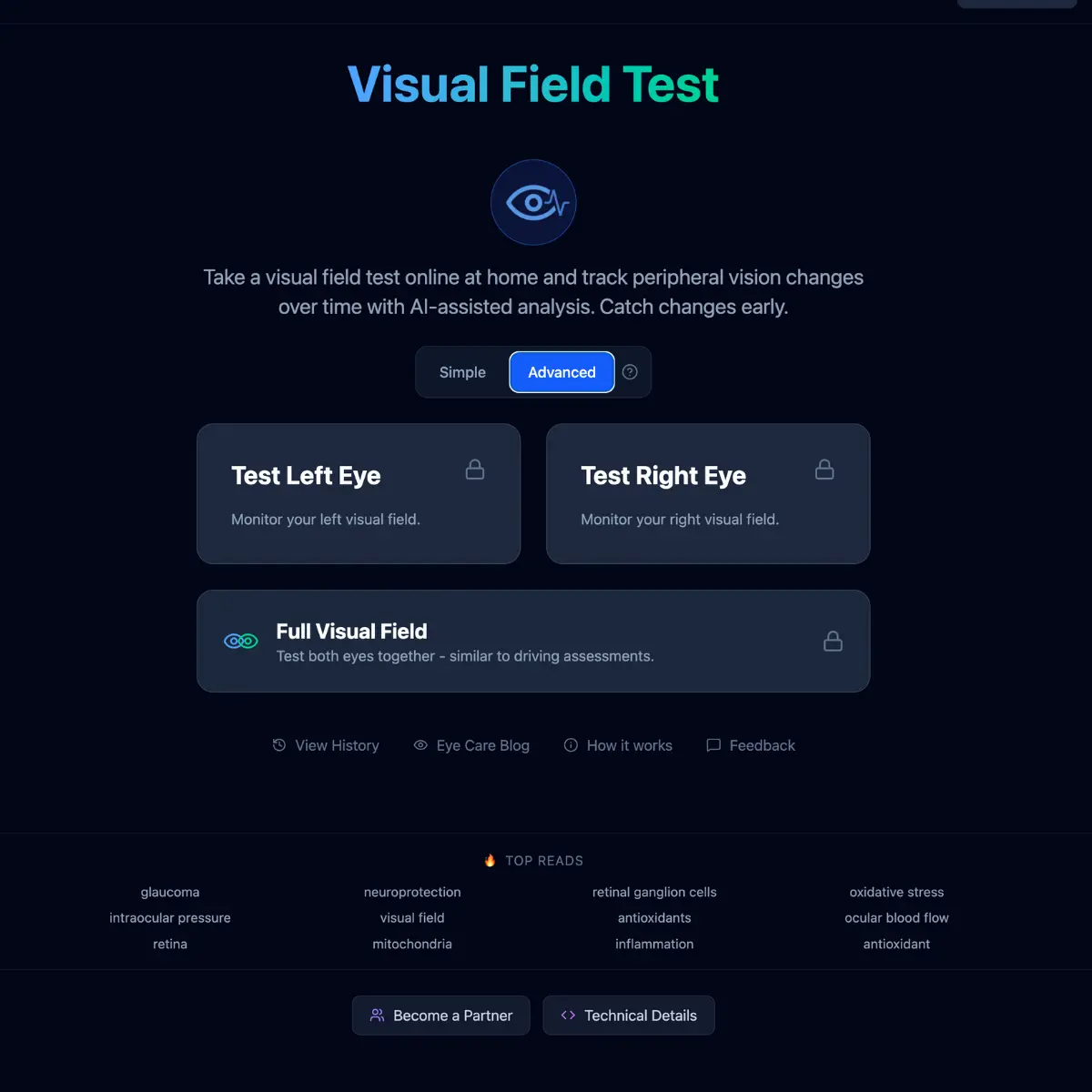
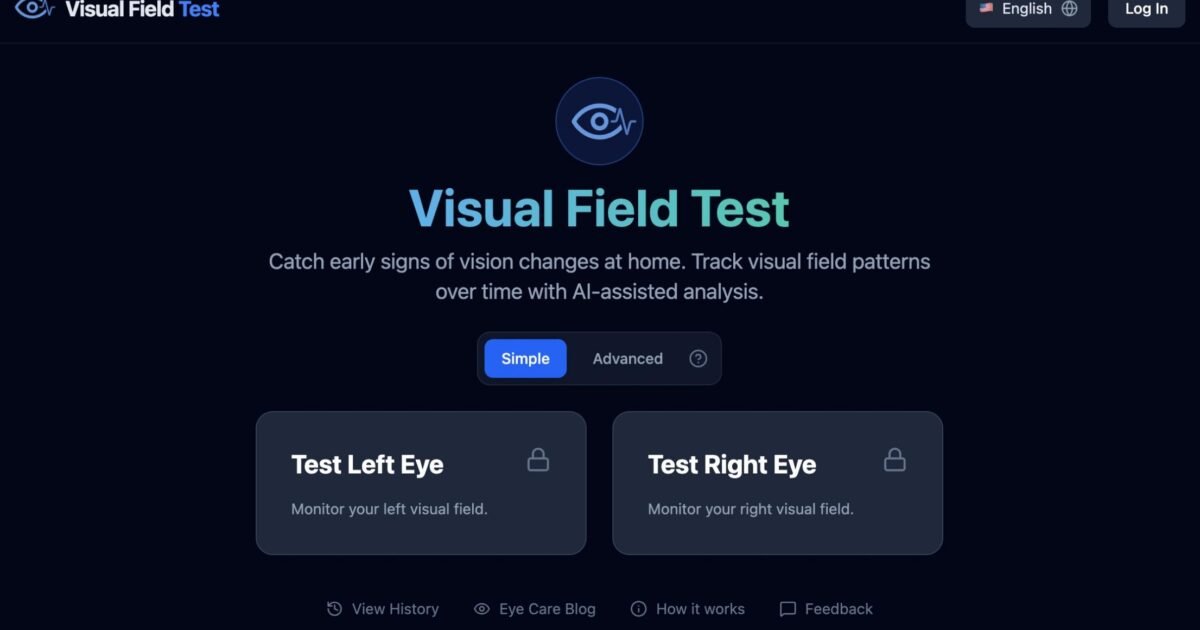
Visual Field Test is a browser-based peripheral vision screening tool that uses behavioral metrics and AI to identify vision loss patterns and generate clinical-style reports for eye care professionals. Visual Field Test offers a convenient way to screen for blind spots and peripheral vision loss without leaving your home. This online testing platform replicates the methodology used in clinical visual field assessments, making it accessible to anyone with a computer or device. The tool is particularly useful for individuals monitoring ongoing eye conditions or those who want to stay proactive about their eye health between professional appointments. Most free online vision tests just show you a map of dots. You clicked here, missed there, end of story. Visual Field Test uses AI to interpret what those patterns actually mean. Missing dots in specific areas can suggest arcuate defects or hemianopia. The AI flags these spatial patterns and explains them in plain language, then generates a clinical report if you want to share results with your eye doctor. You get two test modes. Simple mode requires nothing special from you or your setup, just basic clicks without screen calibration. Advanced mode asks you to measure your screen with a credit card to calculate pixel density, then runs threshold testing that measures sensitivity at each point. Both track your performance: false clicks during catch trials (where no light appears), response times that are too fast, and random retests of points you supposedly saw. All this feeds into a reliability score that tells you and your doctor how much to trust the results. Once you finish clicking through the test, the system uses GPT-5 to look at the map of missed points. Pattern Analysis: It looks for specific shapes in your blind spots. If the missed points follow a certain curve or step, the AI identifies if that pattern is common in specific eye conditions. Reliability Scoring: If you were click-happy or lost focus, the AI flags it. It tells you if your test is actually worth looking at or if you need to redo it. Dual Reports: It writes two versions of your results. One is in plain English for you, and the other uses clinical terminology that you can show to an actual optometrist. The tool doesn’t use webcam eye tracking. That was intentional. Webcams create privacy friction and their quality varies too much across devices. Instead, the app watches your behavior to ensure you’re actually looking at the fixation point. It’s lower-tech but more accessible, which matters when your goal is reaching people who can’t afford a clinical perimeter or live nowhere near an eye care center. The company is explicit about what this isn’t: it’s not a diagnostic device and hasn’t been validated against hospital-grade equipment. It’s a screening tool. You’re not replacing your eye doctor. You’re catching potential problems early, getting data in hand, and knowing whether to actually schedule that appointment. In 30 languages, completely free, no app download required. If you’ve been putting off vision checks because clinics are expensive or inconvenient, this gets you a baseline. If you already have glaucoma or retinal issues, tracking changes over time on your own schedule means you catch drift before your next appointment. Your eye doctor gets real data to discuss instead of guesses.
Key Features
- Pattern Analysis: It looks for specific shapes in your blind spots. If the missed points follow a certain curve or step, the AI identifies if that pattern is common in specific eye conditions.
- Reliability Scoring: If you were click-happy or lost focus, the AI flags it. It tells you if your test is actually worth looking at or if you need to redo it.
- Dual Reports: It writes two versions of your results. One is in plain English for you, and the other uses clinical terminology that you can show to an actual optometrist.
- Simple and Advanced Modes: You can do a quick check without calibration or use the advanced mode where you measure a physical credit card against your screen to ensure the dots are the right size and distance.
- Binocular Testing: A specific mode for both eyes open, which is the standard for driving vision assessments in many regions.
- Longitudinal Tracking: For returning users, the tool compares current results to past ones to see if your vision is actually deteriorating or if it was just a bad day.
- Multi-language Support: It works in 30 languages, making it accessible to a massive global audience that might lack local eye care.
Core Features
Simple and Advanced Modes: You can do a quick check without calibration or use the advanced mode where you measure a physical credit card against your screen to ensure the dots are the right size and distance. Binocular Testing: A specific mode for both eyes open, which is the standard for driving vision assessments in many regions. Longitudinal Tracking: For returning users, the tool compares current results to past ones to see if your vision is actually deteriorating or if it was just a bad day. Multi-language Support: It works in 30 languages, making it accessible to a massive global audience that might lack local eye care.
Pricing
Visual Field Test offers a Freemium pricing model. Visit the official website for detailed pricing information.